
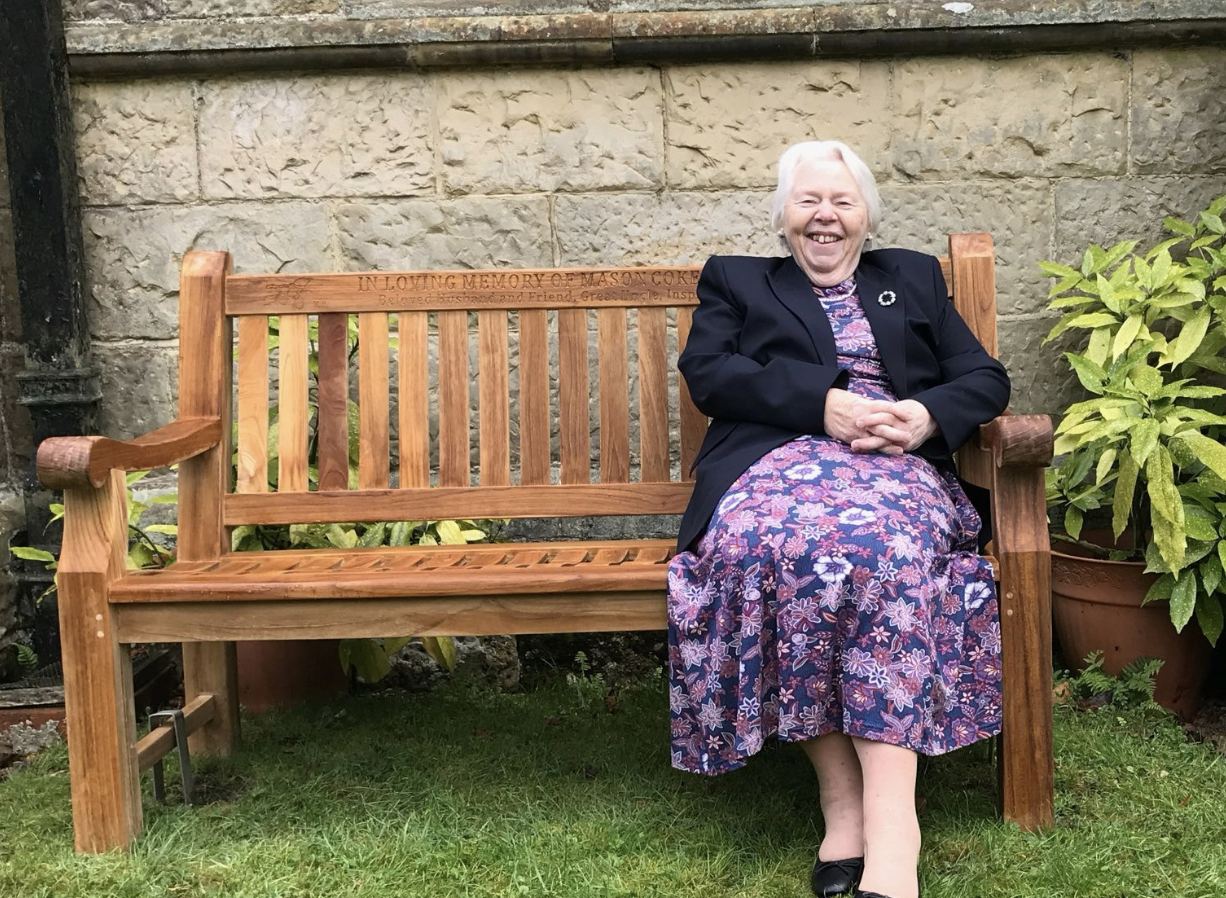
Diana Coker (1942 to 2025)
Diana meant many di7erent things to di7erent people. I’m going to speak about Diana the Osteopath. Those who knew this Diana, either as a colleague, student or patient, knew how incredible she was.
Diana entered the Osteopathic profession as a patient, on the recommendation of her Piano teacher. The first time Diana knew she was going to be an Osteopath herself was when her Osteopath took her to Maidstone College of Osteopathy and, without discussion or explanation, enrolled her on the course...It came as quite a shock to Mason (Diana’s husband), too!
Many wondered how Diana, in her forties, would tackle a four-year full-time clinical course requiring manual dexterity, whilst struggling with ongoing physical disability and pain, as well as the e7ects of head injuries which made studying more di7icult. Despite knowing that a career in Classical Osteopathy would demand a daily physical and mental endurance test, she still took up the challenge...and remained faithful to it.
Hers was a journey of incredible perseverance, the determination to overcome each obstacle with a resolve to rewrite the script. Her first obstacle was crossing a really busy road in front of the college which was challenging for everyone. For Diana it was a military precision ‘dash’, followed by the need to climb a steep, winding staircase to the lecture room! The end of the day required osteopathic treatment to enable Diana to get in a car to drive home and face another day.
When a fellow student questioned how Diana would be able to maintain a practice due to her level of pain, the answer from John Wernham, the college Principal, was: “Her spirit is indomitable!” And so it was: Not only did Diana manage to complete her studies, but she advanced from student to physiology tutor and clinic supervisor, nurturing both students and patients, alike, as well as running her own private practice.
Those who taught or studied with Diana remember her as a popular, immensely kind and valued member of the college. She often stood out as the most welcoming face of encouragement for new students and patients, as well as a ray of light who lit up any room she walked into. And once she had lit up the room, she proceeded to light up others oozing her contagious joy and enthusiasm. It is no wonder that she formed lasting friendships with many of her colleagues and also her Principal, John Wernham, who was often invited for Christmas.
Diana lived Osteopathy in the same way she lived her Faith. She was a poster girl for Classical Osteopathy’s potential, it enabled her to train as an Osteopath and treat others throughout her career. But her environment also needed to be supportive. She replaced the limitations of the college premises with a beautiful living and treating space at home, which she designed herself. It was a real haven to provide the ease and comfort she needed to treat and rest. With the right environment, ongoing care and a lot of fortitude, she defied expectations.
Despite walking around the treatment table on accompanied by her faithful friends, her crutches, she kept a busy diary until just a year ago, aged 82, when a fall forced a career break, but she was determined to get back to serving her patients.
Diana’s relationship with patients went far beyond that of a therapist, she was an ambassador for other’s happiness and wellbeing, a guiding and protective force. Her teaching clinic and private practice overflowed with grateful patients,
benefitting from her infinite wisdom and innate ability to see simplicity in complexity. She was like a Sherlock Holmes of Osteopathy, picking out the key issues behind a patient’s symptoms. One of her patients, so inspired by his treatments from childhood, followed in Diana’s footsteps to graduate as an Osteopath, with Diana beaming with pride to witness his ceremony.
Aside from her patient and teaching success stories, Diana made a significant contribution to Osteopathic terminology. Although not a technical term, she introduced the universally understood term, ‘FLOP’ into the vocabulary, as an ingenious fast track method to ask a patient to relax a tense limb, which, in response, would instantly drop like a ton of bricks into her supporting hand. It became a common term used by John Wernham and a lineage of Osteopaths.
Similarly, Mason had his own contribution, aside from his unshakeable support of Diana throughout her training and career. In the days before electric adjustable treatment tables, Mason made Diana a sturdy wooden step to stand on for when she needed more height to assist her during her student days. That step still remains at the college and served other vertically challenged students long after Diana had left.
Both patients and friends were cherished as family by Diana. They, in turn, reciprocated her love and kindness, often rallying around to support her in any way they could. Perhaps we can understand her enormous devotion to others from a quote she took the time to write in a notebook. This is from an osteopath called Louisa Burns:
“The true Osteopath... must be prepared to do the best possible thing in every conceivable circumstance of human su7ering”
If this is what she was aspiring to, then she more than achieved it. She recognised the transformative value of steadfast and empathic support and as a perennial scholar, drew on diverse knowledge to make sure she was giving the best treatments and advice possible and being the best she could be, as a friend and family member. She was always willing to defend, stand in the gap or pour out her kindnessandthoughtfulnesstothoseluckyenoughtobepartofherlife. Everyone and everything held meaning in her life. The truth is everyone was important to Diana; she cared, really cared, about others and the world.