
Secure your place on the Diploma Course
Postgraduate Diploma Classical Osteopathy
2026-2028
What is the cost in not investing in yourself?
Every practitioner has experienced moments of uncertainty. The patient who doesn’t respond as expected, the complex case that leaves you second-guessing your diagnosis or treatment plan. The patient who doesn’t return because they didn’t get the results they were hoping for.
The institute of classical osteopathy’s post graduate diploma isn’t just another collection of techniques. It’s a complete framework that changes the way you think, assess and treat.
So do you want to:
Build Confidence- not guesswork
See more complex patiences with confidence
Retain more patients
Join a community that continues you support you even after the course
The Post graduate course is an investment that keeps giving back

Want to speak to someone?
Fill in the form, to book in your 20 minute phone call
Want to learn about classical osteopathy?
Why not have a look at our online shop!
WHAT IS CLASSICAL OSTEOPATHY?
Classical Osteopathy brings a traditional view to the profession in the 21st century. Classical osteopathy is a science that studies the organism and the way it works and adapts as viewed through a philosophical lens that seeks understanding of that individual. Classical osteopathy is therefore not merely based on manipulation of parts, but rather on interacting with this individual through the art of Body Adjustment.
Irvin Korr, in his address to the British osteopathic community in 1996 at the Commonwealth Institute London, said;
“I remind you further of another principle. You do not treat symptoms, you do not treat pain, you do not treat diseases, you do not treat parts of the body, you do not treat the musculo-skeletal system; you treat persons, you treat human beings. It is they who get well or not, depending on the competence of their built-in health care system. I would like to hear you saying this more and more, that you are treating more than a musculoskeletal system.”
The overriding principle of classical osteopathy is therefore not bony adjustment, but body adjustment. Our traditional philosophy is what makes classical osteopathy distinct. And it is this philosophy which is taught on the Institute’s courses.

#1 Fundamental Concepts
Classical osteopathy is a system of healing which was formulated over a hundred years ago by AT Still and then further interpreted by JM Littlejohn and continues to be practised and developed today. It encompasses the Hippocratic concept of Vis Medicatrix Naturae, ‘the healing power of nature’, where the body is seen not merely as a machine, but rather as a vital living organism with a natural tendency towards self-healing, elimination and continuation. The development of disease depends on many factors which can divert the vital force or the vitalising processes of the individual and therefore compromise the organism’s ability to respond.
In seeing the individual as an integral being, it becomes possible to understand the way in which the organism is responding, the behaviours exhibited, and the purposes served by the physiological processes that are running. Any alteration in physical arrangement will have expected concomitant alterations in physiological behaviour. It follows, therefore that the osteopathic lesion is not merely a bony alteration, but also a predictable physiological one, and that any dis-ease or disturbance will be addressed through physiological processes.
This process was termed simply as ‘Adjustment’ by JM Littlejohn and implies structural adjustment, including bones, muscles, ligaments, blood vessels etc. , neurological adjustment and adjustment of the individual to their environment by considering factors such as diet, hydration level, sanitation, social interactions, stress levels, sleep pattern and so on.
#2 Applied Physiology
The notion of the body as a vital living organism is fundamental to classical osteopathy. Each individual has within their body vital forces, vitalised fluids and vitalising processes which maintain the normal equilibrium of the body. A healthy body relies on ‘unity’ of the whole, or “the proper play and correct relation of all the integral parts of the organism, including the correct articulation of the entire skeleton, the proper relations of the muscles, fascia, ligaments, cartilages and tendons to one another and to their skeletal attachments, the exact anatomical structure and physiological action of the blood vessels and the nerves of the body organism, so that all these in interdependence upon one another and in correlation to the organism as a whole for the basis of the vital forces of the body”.
These relationships are mediated through the nervous system, which not only provides sensory information to the higher centres but also cerebrospinal fluid, which is highly vitalised and trophic, is produced in the choroid plexuses of the ventricles of the brain and is distributed along the spinal canal and the pathways of all the nerves to the periphery and to every tissue of the body - and then back again ad infinitum. It is the neuro-endocrine system which coordinates and controls the activity of the organism as a whole in any reaction to its surroundings and itself. Hence, the afferent impulse or sensory stimulation is always the starting point of the activity, normal or otherwise.
The object of osteopathy is therefore to allow the absolute or maximum activity of the vital processes. This is achieved via the vasoactive components of the nervous system by i) relaxation of contracted tissues and contraction of relaxed soft tissues, ii) adjustment of bone, cartilage tendons to each other and to the whole, iii) inhibition of overactive tissues via the nerve centres, iv) stimulation of inactive tissues through the nerve centres, and v) establishing free and uninterrupted currents of vitality.
Still recognised that there was a somatic component to disease, and the intervention of the osteopath is through skilled osteopathic technique to ameliorate those aberrant reflexes. The modern term being allostatic load.
Primary Concepts & Patho-Physiological Mechanisms in Osteopathic Medicine.
Mervyn Waldman
#3 Applied Mechanics
Although the body is a vital living organism, it is, as are all structures, subject to the laws of gravity. Although this gravitational load is normal, it is the inability to sustain this demand and the subsequent altered position of the body in relation to gravity that has altered physiology and hence disease. As Fryette reminded us “gravity is the great killer of the body”. Ignoring the effect of gravity will therefore provide temporary relief of the lesion state only. We have to think in terms of parallel and non-parallel forces and of curved forces as they act over the spinal arches, and more importantly, of the problem of weight-bearing as it operates on the normal or altered structure. The living organism must be mechanically sound but must also be segmentally and collectively free to be able to function normally. “Fixation at one point of the spine will find expression throughout the column.”
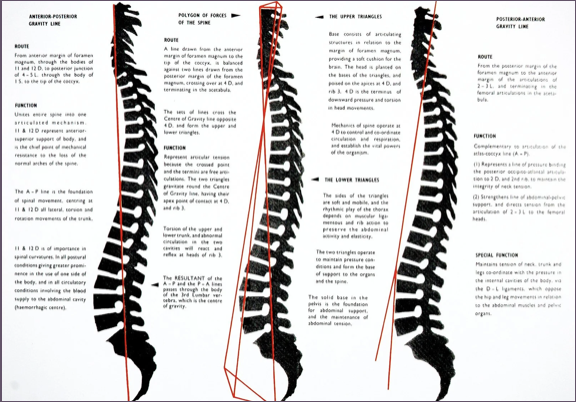
Curved lines or spinal arches provide a dynamic representation of the spinal column, whereby the four arches provide a balance between the primary dorsal and sacral arch and the secondary cervical and lumbar arches. The most important factor in spinal balance is the double arch from D5 to 2L – commonly known as the ‘power house’ of the spine – acting as a link between the upper and lower parts of the body.
It is essential to our work as classical osteopaths to remember that the above-discussed straight and curved lines are essential for the well-being of the living moving body and that any functional derangement surrounding a spinal segment will result in altered afferent nervous input, reduced circulation and nutrition, toxic conditions and atrophy.
This is why “no amount of correction will avail much in the treatment and recovery of the patient, unless the static and dynamic structures are brought into play, alongside the joint release and relief of soft tissue rigidity”.